| |
|
|
 Home / AEO Home / AEO
AEO
-
-
-
In the dynamic world of global commerce, maintaining efficient, secure, and compliant international trade operations is essential for sustainable business growth. One of the most effective ways to strengthen your international trade processes is by obtaining Authorized Economic Operator (AEO) Certification.
Bangalore, as one of India's leading industrial, commercial, and technology hubs, is home to a wide range of importers, exporters, manufacturers, and logistics companies engaged in global trade. For these businesses, AEO Certification in Bangalore can provide significant advantages, including faster customs clearance, reduced compliance requirements, enhanced supply-chain security, and greater credibility with international trading partners.
The AEO certification process, however, involves detailed documentation, internal process assessments, compliance requirements, and coordination with Customs authorities. This is where experienced AEO Consultants in Bangalore play a crucial role. Specialized consultants help businesses understand the eligibility criteria, prepare the required documentation, strengthen internal controls, identify compliance gaps, and navigate the certification process efficiently.
3 Tiers of AEO Certification in India
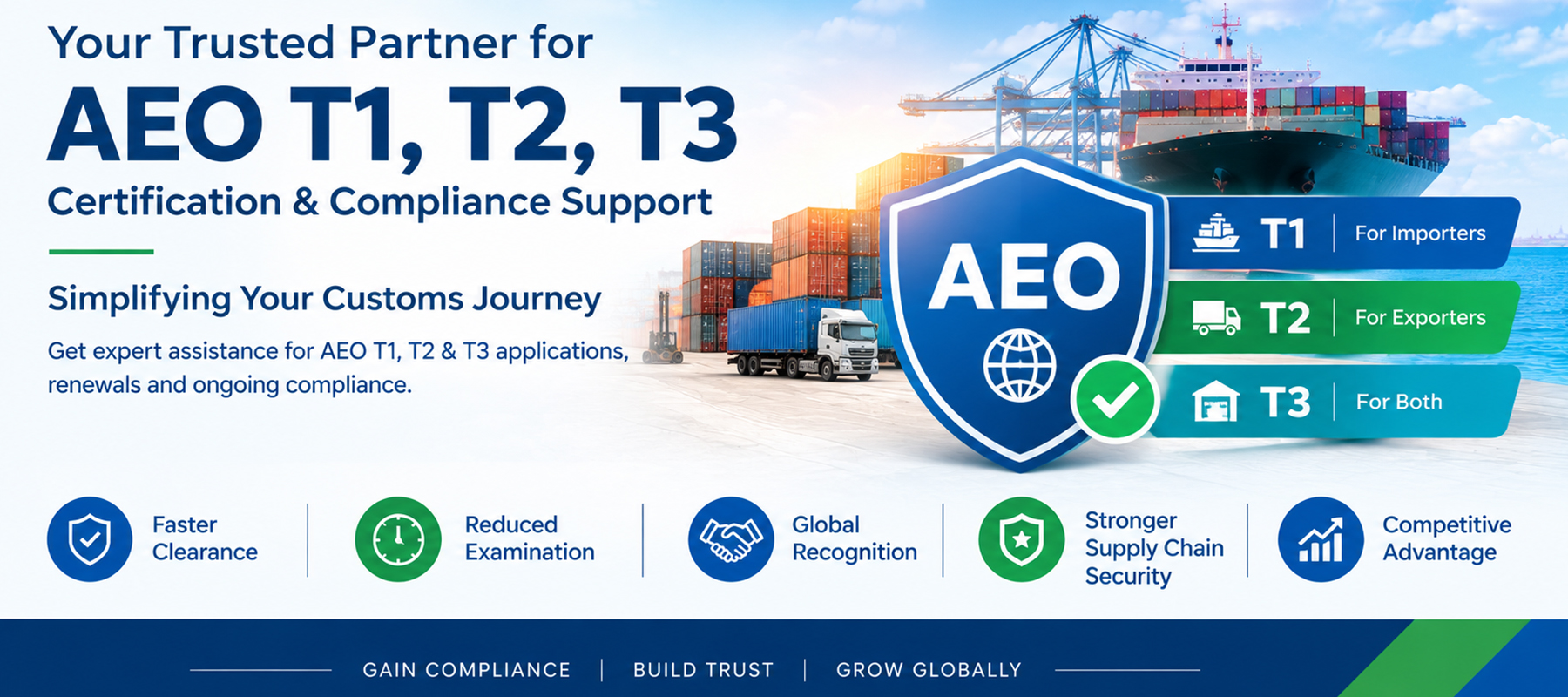
AEO Certification in Bangalore is generally structured into three main tiers—AEO T1, AEO T2, and AEO T3—along with AEO LO for other eligible economic operators. Each category has different eligibility requirements, verification procedures, and associated benefits.
1
AEO T1 – Document-Based Certification
AEO T1 is available to eligible importers and exporters who meet the prescribed AEO eligibility and compliance criteria. The certification is primarily based on documentary verification, with the focus on assessing the applicant’s compliance history, financial standing, record-keeping systems, and customs-related processes.
2
AEO T2 – Document & On-Site Verification
AEO T2 is also applicable to eligible importers and exporters and involves a more comprehensive assessment than T1. The certification process includes document verification as well as on-site verification of the applicant’s business premises, systems, procedures, internal controls, and supply-chain security measures.
3
AEO T3 – Highest Level of AEO Certification
AEO T3 represents the highest level of AEO accreditation for eligible importers and exporters. It is intended for businesses that have demonstrated a sustained record of customs compliance and have generally held AEO T2 status for the prescribed period. The assessment involves a detailed review of the applicant’s compliance framework and physical verification of relevant premises and processes.
AEO LO – Logistics & Other Economic Operators
AEO LO is applicable to eligible economic operators other than importers and exporters. This category may include logistics service providers, terminal operators, custodians, customs brokers, warehouse operators, and other qualifying entities involved in the international supply chain.
Why AEO Certification Is Crucial
Obtaining Authorized Economic Operator (AEO) Certification can provide significant advantages to businesses engaged in international trade. It demonstrates a company’s commitment to customs compliance, supply-chain security, transparency, and efficient trade practices. Key reasons why AEO certification is important include:
Enhanced Supply-Chain Security
AEO certification encourages businesses to implement robust security standards and internal controls, helping minimize the risks associated with theft, fraud, unauthorized access, smuggling, and other supply-chain threats.
Facilitated Customs Procedures
AEO-certified businesses can benefit from simplified and expedited customs procedures, helping reduce clearance times and ensuring smoother movement of goods across international borders.
Reduced Inspections and Interventions
Eligible AEO holders may receive greater facilitation during customs clearance, including reduced frequency of physical examinations and documentary checks, subject to applicable Customs procedures.
International Recognition
AEO status can strengthen a company’s credibility in international trade. Where Mutual Recognition Agreements (MRAs) are applicable, AEO status may provide additional facilitation when trading with participating partner countries.
Competitive Advantage
AEO certification distinguishes a business as a trusted and compliant trading partner. This can strengthen relationships with customers, suppliers, logistics providers, and other international business partners.
Operational and Cost Efficiency
By improving customs processes, documentation, internal controls, and supply-chain security, AEO certification can help businesses reduce delays, minimize operational disruptions, and improve overall trade efficiency.
Key Benefits of AEO Certification
Achieving AEO status can provide a range of operational and strategic benefits that contribute to smoother and more efficient international trade operations.
Priority and Faster Customs Processing
AEO-certified entities may receive priority treatment and faster processing of consignments, helping reduce clearance time and improve supply-chain predictability.
Benefits Under Mutual Recognition Agreements
Where applicable, Mutual Recognition Agreements (MRAs) can extend AEO-related facilitation to partner countries, helping simplify customs procedures and strengthen international supply-chain cooperation.
Secure and Trusted Supply Chains
AEO certification promotes stronger security practices across the supply chain. This helps businesses reduce risks related to theft, tampering, unauthorized access, and security breaches while building greater confidence among supply-chain partners.
Improved Compliance and Internal Controls
The AEO framework encourages businesses to establish effective customs compliance systems, documentation procedures, record-keeping practices, and internal controls, resulting in better governance and reduced compliance risks.
Enhanced Business Reputation
AEO status demonstrates a company’s commitment to customs compliance, security, and responsible international trade practices, strengthening its reputation among customers, suppliers, financial institutions, and global trading partners.
Simplified Customs Processes
AEO-certified businesses may benefit from simplified procedures and reduced administrative burdens, allowing teams to spend less time managing routine customs-related processes and more time focusing on core business operations.
Improved Market Access
AEO certification can strengthen a company's position when entering new international markets by demonstrating that it follows recognized standards of customs compliance and supply-chain security.
Greater Supply-Chain Predictability
Faster and more predictable customs procedures can help businesses improve inventory planning, delivery schedules, logistics management, and customer service, ultimately supporting greater efficiency in global trade.
Our Expertise, Your Advantage
Kelular Consulting is a team of experienced professionals with in-depth knowledge of Authorized Economic Operator (AEO) certification and related customs procedures. We assist businesses in understanding the applicable AEO requirements, preparing the necessary documentation, and managing the application process for AEO-T1, AEO-T2, AEO-T3, and AEO-LO certification.
Our approach focuses on ensuring that your application is accurate, complete, and aligned with the prescribed AEO requirements, helping reduce documentation gaps and avoid unnecessary delays during the certification process.
Why Choose Kelular Consulting?
- AEO Expertise: In-depth understanding of AEO certification requirements and procedures.
- End-to-End Assistance: Support from eligibility assessment to application submission and certification.
- Documentation Support: Assistance in preparing and reviewing the required forms, annexures, and supporting documents.
- Compliance Guidance: Guidance on meeting the prescribed customs compliance and supply-chain security requirements.
- Application Monitoring: Regular follow-up and monitoring of the application process.
- Tier-Specific Guidance: Assistance for AEO-T1, T2, T3, and AEO-LO based on your business requirements.
- Practical Approach: Focused on identifying documentation gaps and compliance issues before submission.
- Dedicated Support: Personalized assistance throughout the AEO certification journey.
AEO stands for Authorized Economic Operator. It is a status or certification granted to eligible economic operators by the AEO Programme authorities based on their compliance with prescribed customs, security, and supply-chain requirements.
AEO (Authorized Economic Operator) certification is a voluntary trade facilitation and compliance programme established under the World Customs Organization’s (WCO) SAFE Framework of Standards. It is designed to strengthen supply-chain security while facilitating legitimate international trade. In India, the AEO Programme is administered by the Central Board of Indirect Taxes and Customs (CBIC), providing eligible businesses with various customs facilitation benefits based on their level of compliance and security standards.
The Indian AEO Programme offers three tiers of certification for importers and exporters: AEO-T1, AEO-T2, and AEO-T3, with AEO-T3 being the highest level of accreditation. Each tier provides different levels of customs facilitation, benefits, and compliance recognition based on the applicant’s level of security and compliance.
A separate category, AEO-LO (Authorized Economic Operator – Logistics Operator), is available for supply-chain entities that are not directly involved in importing or exporting goods. This category covers entities such as customs brokers, logistics service providers, custodians, consolidators, terminal operators, and warehouse operators.
The Indian AEO Programme provides a three-tier AEO status for importers and exporters, with each tier offering progressively higher levels of customs facilitation and benefits.
AEO-T1 is the first tier of the AEO certification and is generally granted based on document verification of the applicant’s compliance with the prescribed eligibility and security criteria. While AEO-T1 offers several customs facilitation benefits, its benefits are more limited compared with AEO-T2 and AEO-T3, which provide enhanced levels of facilitation.
AEO-T2 is the second tier under India’s three-tier AEO Programme for importers and exporters. It is granted based on document verification along with physical verification of the applicant’s premises and compliance with the prescribed AEO criteria.
AEO-T2 provides enhanced customs facilitation and benefits compared with AEO-T1, recognizing businesses that demonstrate a higher level of compliance, security, and control over their international supply-chain operations.
Businesses seeking AEO certification must meet certain eligibility criteria prescribed under the Indian AEO Programme. MSMEs should have handled at least 5 import/export transactions (Shipping Bills and/or Bills of Entry) during each half-year period, with a minimum of 10 transactions annually. For other enterprises, at least 25 such transactions during the preceding financial year are required.
In addition, the applicant must be engaged in customs-related activities, form part of an international supply chain, and apply as a single legal entity. The business should also have been actively operating for the preceding three financial years. However, the three-year operating requirement may be waived in deserving cases, subject to the applicable AEO guidelines.
AEO-T3 provides a higher level of customs facilitation and additional benefits compared with AEO-T1. Key advantages include container scanning based only on specific intelligence, acceptance of self-certified supporting documents, exemption from bank guarantee requirements, and risk-based intervention by other government agencies.
AEO-T3 holders may also benefit from faster processing of refunds and rebates within 30 days and On-site Post Clearance Audit (OSPCA) once every three years. In comparison, AEO-T1 generally involves a 50% bank guarantee requirement and standard customs scanning procedures, subject to applicable conditions.
Yes. AEO certification can provide international trade facilitation benefits through Mutual Recognition Arrangements/Agreements (MRAs) between Indian Customs and the customs administrations of partner countries. For AEO-T2 and AEO-T3 holders, these arrangements may allow the partner country to recognize their AEO status, potentially resulting in reduced customs examinations, fewer inspections, and streamlined verification procedures for eligible shipments.
This can help AEO-certified businesses achieve faster and more predictable customs clearance when trading with countries covered under the applicable MRA.
A business entity involved in the international supply chain can apply for AEO certification if it meets the prescribed eligibility and compliance requirements under the Indian AEO Programme. The key criteria include:
- Transaction Requirement: Have handled at least 25 customs documents, such as Shipping Bills and/or Bills of Entry, during the preceding financial year.
- Customs-Related Activities: Be actively engaged in customs-related work or activities.
- International Supply Chain: Form an integral part of the international supply chain.
- Single Legal Entity: AEO certification is granted to a single legal entity and not to a group of companies as a whole.
- Business Track Record: Have been engaged in business activities for the preceding three financial years. This requirement may be waived in deserving cases, subject to the applicable AEO guidelines.
Maintaining AEO status is essential for ensuring continued compliance and maximizing the benefits available under the AEO Programme. After obtaining AEO certification, the organization must consistently maintain the prescribed customs compliance, security, and supply-chain standards on which its AEO status was granted.
The AEO certification reflects the company’s commitment to secure and compliant international trade practices. Therefore, the company should regularly monitor its processes, maintain proper records, comply with applicable customs requirements, and promptly address any changes that may affect its AEO eligibility or compliance status.
An AEO application requires basic company documents along with supporting documents demonstrating the applicant’s customs compliance, financial standing, and supply-chain security measures. Commonly required documents include IEC, GST Registration Certificate, Certificate of Incorporation, MSME Certificate (where applicable), Import-Export Process Map, Site Plan, Solvency Certificate, Audit Reports, and other documents as prescribed under the AEO Programme.
The relevant annexures generally include:
- Annexures 1 and 2: For AEO-T1 applicants.
- Annexures A to E5: For AEO-T2, AEO-T3, and AEO-LO applicants.
- MSME Annexures 1 and 2: For AEO-T1 applicants holding a valid MSME Certificate.
- MSME Annexures 1, 2, and 3: For AEO-T2 applicants holding a valid MSME Certificate.
The exact documentation may vary depending on the AEO tier, applicant category, and applicable CBIC requirements.
|
|
|
|
|